

“The start of a new era.”
This is the new BMW iX3. And while the name and general shape are familiar, there is in fact basically nothing about this car that’s similar to the modern BMWs you know and see on the roads.
BMW is not typically one for hyperbole, and a 58-page press release is also somewhat atypical for the brand.
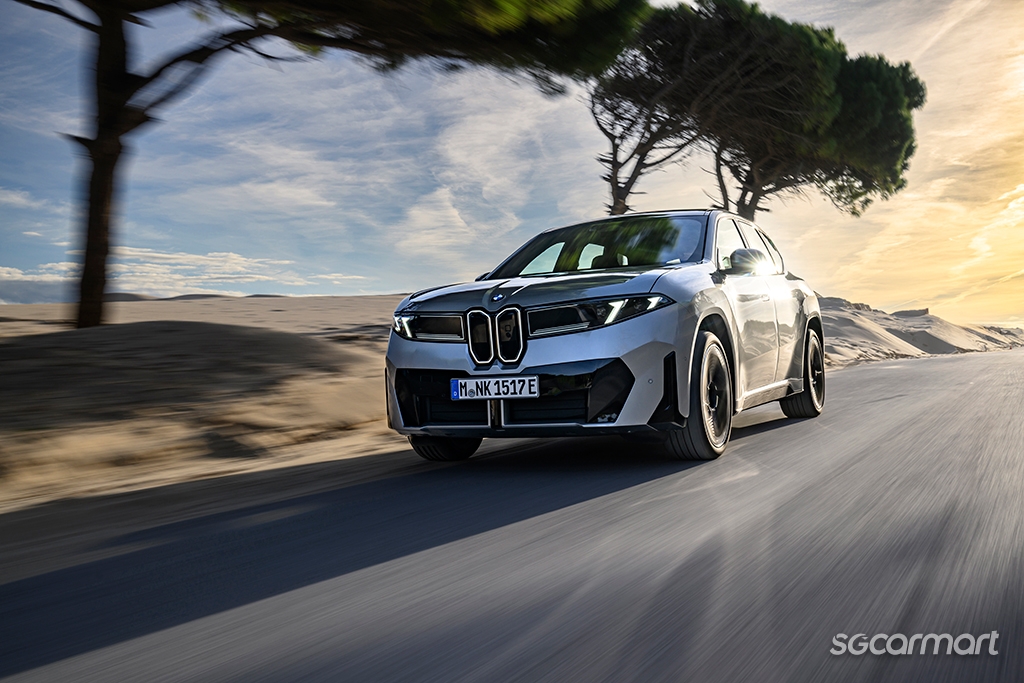

But then the iX3 isn’t just another new car. Just about everything on this car is brand new. More importantly, this truly does herald in a new era for BMW — not just a new generation of cars, but also a new generation of technology and functionality. It’s what the brand is calling its Neue Klasse. (Not to be mistaken with the original Neue Klasse of the 60s; shall we call it the new Neue Klasse?)
And so this car is more than a big deal for BMW. It’s a huge deal, because this is the first and arguably most important litmus test for the brand’s next-generation of cars — the technologies found in this car will make their way into 40 new and updated models by 2027.

New design language
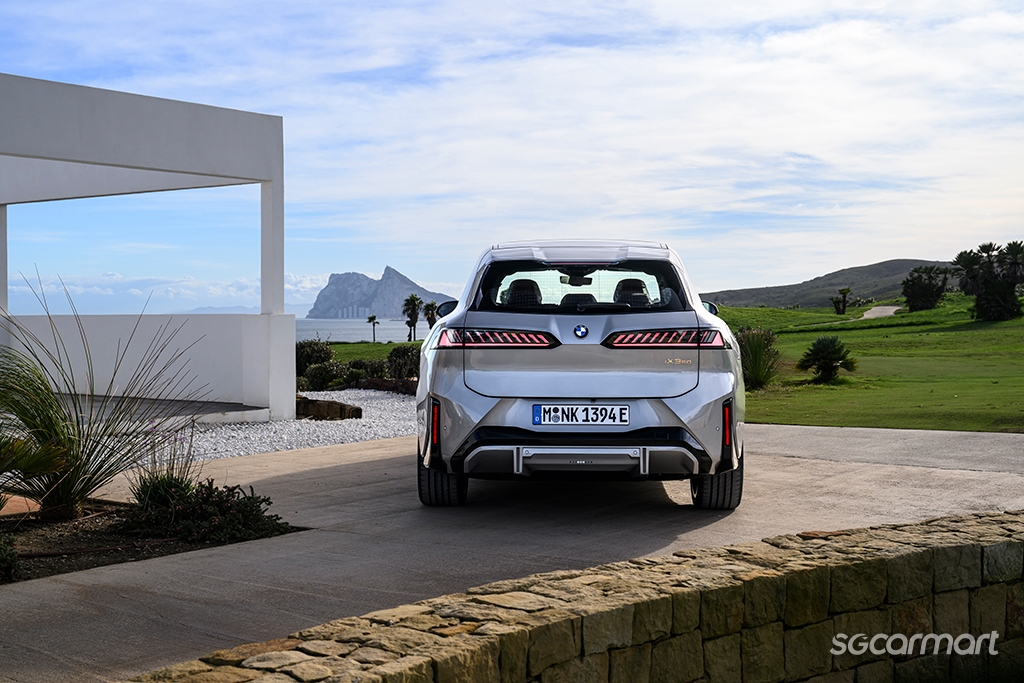
Let’s start first with how the car looks. This is the new generation design language, and most people will immediately identify the new-look kidney grille. It’s not gigantic! Yes, this vertically arranged kidney grille harkens back to the original Neue Klasse models like the 1600, but this reinterpretation of the kidney grille is emblematic of BMW’s broader design shift.
It’s a reductive approach — with efforts made to shrink rather than enlarge (which seemed to be the case with the brand’s more recent models — the huge grille on the M3/M4 comes immediately to mind).


Light has been much more deliberately used here in place of chrome — not just in the grille surrounds (illuminated grilles are quite trendy now), but also in texturing the front panel as it stretches toward the new-look twin head lights. At the rear, light is once more the predominant design element, but again organised with thinness and sleekness in mind.
Combined with the simpler shapes across the sheet metal, the result is a car that seems to visually shrink in size. In this era of continually growing cars, I think that’s a great result.

Reductive reasoning
Pop open the doors and you are greeted by a completely new space, here also distinguished by a clear effort in reduction.
That effort is chiefly organised with BMW’s new Panoramic iDrive concept, which consists of four elements: The new steering wheel, the Central Display, the Panoramic Vision display, as well as the 3D head-up display.
The attention-grabbing feature is that Panoramic Vision display that runs from A-pillar to A-pillar — it quite literally dominates your eyeline.
That said, it’s executed well. Driving information is permanently displayed in front of you (that ‘portion’ effectively replaces the traditional instrument cluster), while the rest can be configured to display a variety of information, from navigation instructions to music information to even the weather. I never found it distracting or obstructive, and I did like the animated Intelligent Personal Assistant graphic (it’s quite common already in many Chinese cars).
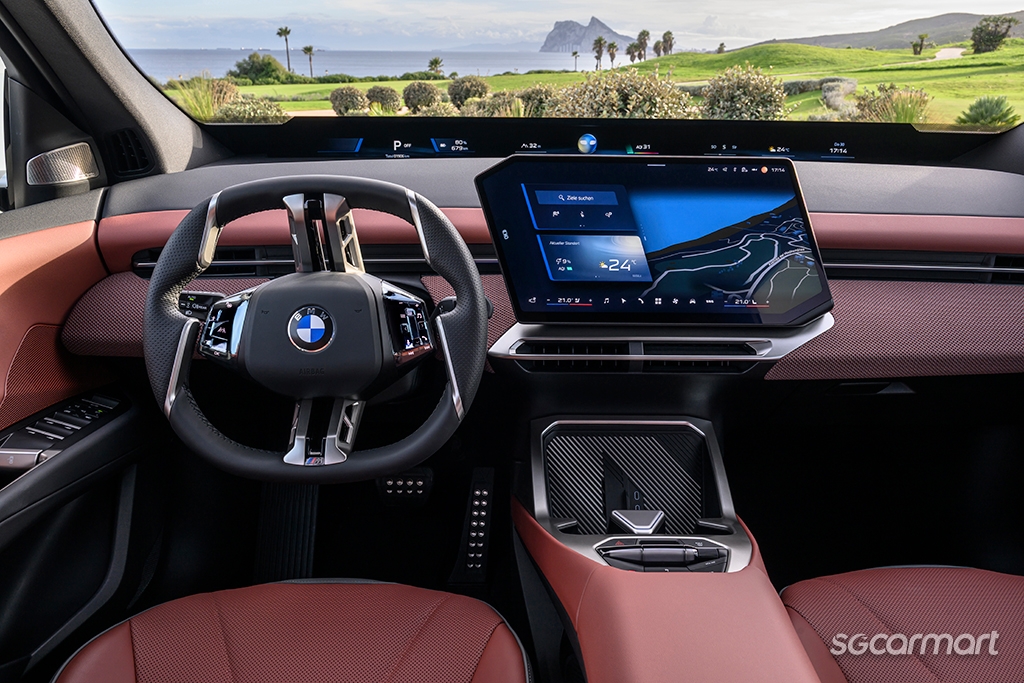
The Central Display itself is nothing particularly groundbreaking, though the locating of useful QuickSelect shortcuts (like turning off the speed limit warning) on the edge closest to the driver is smart. I do sincerely hope that the “left-leaning” hexagonal screen (which puts those shortcuts in very convenient reach of your right hand) is appropriately flipped for right-hand drive markets.
I particularly like the new steering wheel. The integration here of ‘shy-tech’ works well – relevant controls only light up and ‘appear’ when necessary. For example, the left set of controls are for the cruise control settings, and only when activated do the relevant controls for increasing/decreasing speed appear.


But perhaps most importantly, I just like the size of it. I don’t have the empirical dimensions, but the wheel feels smaller in diameter, also likely helped by the cut-out for you to place your thumbs. BMW steering wheels have been wrongly trending in the bigger and thicker direction in recent years, and this new steering wheel feels refreshingly right-sized.
All of it runs on the new Operating System X, which is expectedly deep and packed full of features that I suspect most drivers will seldom use. The good news is that the homescreen can be configured with your most regularly-used features, so once done there’s no real need for any menu diving.


The consequent result of these four combined elements is a seamless driving experience. While there’s certainly plenty to play with if you wanted, actually it’s quite easy to keep your hands on the wheel and eyes on the road, just as the brand intends.
The rest of the cabin exudes the same pared down feeling, with fewer controls and buttons helping the space feels more airy and decluttered. Paired with quality materials and especially this Castanea colour, it definitely gives off designer lounge vibes. The ambient lighting peeking out under the fabric trim on the dash accentuates this almost modernist aesthetic.

New drive archetype
The iX3 debuts BMW’s 6th generation eDrive system, and there are important changes here. Perhaps the most notable one is the battery, and specifically the battery cells. This Gen6 eDrive system uses new cylindrical cells, which boasts a 20per cent higher density.
This means the 108.7kWh battery has a quoted range of 805km, which is quite a large number indeed. For reference, most cars with 100+kWh batteries today offer somewhere between 600-700km of range.
Even BMW’s largest current Gen5 battery, the 101.7kWh battery found in the i7, has a max range of 611km. And during my brief test drive with the car, the on-board computer suggests that we would actually achieve closer to 865km.
That improved range also comes as a result of more efficient electric motors. But don’t imagine that better efficiency comes at performance trade off. This iX3 50 xDrive packs two motors that deliver 345kW and 645Nm of torque, meaning the century sprint can be done in 4.9 seconds.
Again, more straight line performance than any family SUV needs, but this is pretty par for course for modern electric SUVs now. (Less-powerful, more-affordable variants of the iX3 will of course eventually be introduced.)


Core to the Neue Klasse is a new system architecture, headlined by the ‘Heart of Joy’. BMW says it’s a “superbrain” that consolidates and integrates a wide-range of driving functions into a single controller, and there’s obviously plenty of technical jargon here to wade through.
It’s also hard to pinpoint exactly what it does across varying driving situations (because it’s actually doing a lot), but what I can tell you is that the iX3 has an attentiveness about it that you would not expect from a somewhat high-riding SUV.
There’s an immediacy to inputs, combined with an increased feeling of effortlessness. Steering is generally light and responsive even with just your fingertips, braking is well modulated, and acceleration out of corners is rapid yet controlled.
Going up and down the windy mountain roads just north of Sotogrande, Spain, the iX3 feels relatively lively and responsive, especially when considering the car’s 2.3-ton kerb weight. The car does a fantastic job of disguising that heft, and its genuinely something you don’t think or worry about.

I also liked how I could navigate tighter downhill sections without having to step on the brake pedal — the regenerative braking is sufficient in the stronger settings to slow the car down, and will prioritise more braking when it detects tighter/slower corners.
Another notable effect of the upgraded driving systems is how the car stops. BMW says that in everyday driving, 98per cent of the braking is done using regenerative braking, even when you are stepping on the brake pedal.
This enables the Soft Stop function — adjusting the amount of recuperative braking to deliver a seamless, jerk-free stop. And it’s good — I think even better than I can manage with my right foot. (I desperately wish every Grab driver had this feature, good lord.)
I did also get to chuck the car around a few corners on the Ascari Circuit, though admittedly a car fitted with wider, stickier tyres. Even so, there was a sharpness and agility to the car better than I expected, though it’s hard to make a definitive evaluation without some other prior benchmark.

BMW is also making a big deal about the upgraded autonomous driving features, what it’s calling Symbiotic Drive.
One worthy function to point out is that with Automatic Cruise Control on, you can still operate the throttle and brakes, as well as feed light steering inputs, without the system shutting off.
This is actually a very good idea — you can close up gaps/brake early if the situation requires it, but the preset speed/distance and the steering assistance remains active. You don’t have to reengage the system plus set the desired speed each time as is currently the case. This effectively allows you to leave the system always on, while still having granular control over the car.
This also holds true for the Lane Departure Warning: When the system detects eye movement to lane change, it won’t intervene. This means that if you are like me and can’t stand that intervention, you won’t have to turn it off every time you get in the car. Just make sure to check your blind spot (and please indicate).


The Motorway Assistant also works seamlessly — completely hands-free driving including the ability to switch lanes just by looking in the side-view mirror. I can imagine this being extremely useful in places like Europe where you could have hours-long journeys on highways when travelling between cities. Singapore? Probably less relevant.
I also do like that when adjusting to changing highway speed limits, the car adapts in a much more progressive and imperceptible manner. For example, when cruising at 120km/h and it detects an upcoming 80km/h limit, it actually starts gradually decelerating some ways before entering that reduced-speed zone.
This is effective is minimising the sudden acceleration/deceleration you would feel in some existing cruise control systems, but arguably more important in reducing the anxiety the driver might have in full trusting such a hands-off system.
Is it truly symbiotic? Obviously not, but it is a meaningful step closer, and more importantly actually makes living with these assistance systems much easier. It feels both more useful and less intrusive.
All in all, it is quite the impressive driving package. I think all the various systems here have been integrated in a manner that feels comprehensive yet at the same time less directly perceptible.

i on the future
This story is atypically long, but then again this isn’t a typical new car being launched.
Truth be told, it’s hard to fully wrap my head around the iX3. There’s so much going on — both above and beneath the skin. It’s certainly a huge leap forward from the current generation model, and just a day of driving it is just scratching the surface.
A lot of other features, likes charging capability, remote parking and connected services, can only be fully evaluated by spending more time with the car (when it arrives in Singapore).
There is no avoiding the reality that some of the developments heralded by the iX3 and more broadly the Neue Klasse is BMW catching up to contemporary competition. 800V architecture, 400kW charging, bi-directional charging, these are features already found on many competitor cars.
But there’s also plenty of future-proofing in mind. The new architecture is designed not just for better on-road capability and manufacturing efficiency, but also to be able to be upgraded in the future (with necessary processing power to spare).
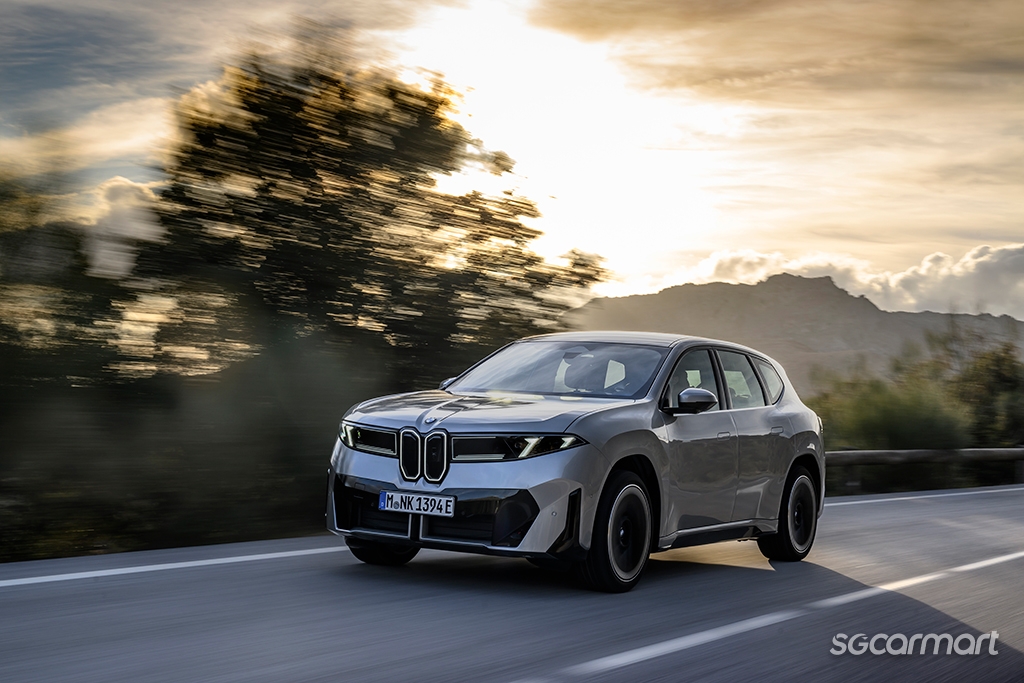
Thankfully, one key takeaway is that the car remains accessible. For what the brand is calling a “true software-defined vehicle”, the tech does not overwhelm – for the uninitiated/uninterested, you can still simply get in, turn it on, and drive away. Even if you never explore/exploit all the complex features and technology packed within, it’s still a fundamentally familiar BMW SUV.
But approaching it as just another BMW SUV would be doing it a disservice, because it’s so much more than that. This is representative of the future of BMW — one that is clearly technology and software-driven.
The Neue Klasse is a big step forward for the brand, even if there aren’t necessarily many revolutionary, headline-grabbing features being rolled out. (Our understanding is that a lot of these features are also designed with application to existing platforms in mind, and not exclusive to the new EV architecture.) Of the lot, I think the significantly improved efficiency of the Gen6 eDrive system is most outwardly notable.
There’s of course the big question of price. The more expansive feature set, with so much more technology packaged in, should expectedly make the car more expensive. However, the development of the iX3 (and the Neue Klasse more broadly) has also been done with an eye on costs – to make these cars more efficient to produce, but with reduced costs as well.
The net result, hopefully, is that the new iX3 is not significantly more expensive that the “equivalent” outgoing model. We understand that for Singapore, the car is estimated to cost 10per cent more than the outgoing iX3 — though admittedly the exact specification may vary (and of course, COE).
That top-line takeaway could already be enough for the iX3 — significantly better range, wide-ranging upgrades in terms of functions and features, but without a huge jump in price. That’s a win for customers, and thus for the brand.

And then there’s the broader conversation around product and brand identity.
Some people will continue moaning about the loss of petrol power and a V8 soundtrack, but the hard reality is that the automotive sector continues to evolve, and with electrification very much at the forefront (if not quite the endgame that many brands had previously committed to).
Digitalisation, too. Understandably, no brand is going to take backwards steps when it comes to technology — buyers who pine after rawness and simplicity can continue to shop in the used market.
Technology will continue to progress, and concurrently enable cleaner, more sophisticated cars.
Better cars, as this iX3 demonstrates.
So like it or not, this is certainly going to be a new era for BMW. And by the looks of it, it’s quite an exciting one.
The new BMW iX3 is expected to be launched in Singapore in the middle of 2026.
What we like
- Significantly improved battery efficiency
- New design language makes the car look more compact
- Pared down cabin increases sense of space and refinement
- New digital user experience works seamlessly
- Upgraded drive systems deliver all-around improvements
What we dislike
- Some autonomous functions may not be as relevant to Singapore
[[nid:725986]]
This article was first published in sgCarMart.
Top In Asia


