

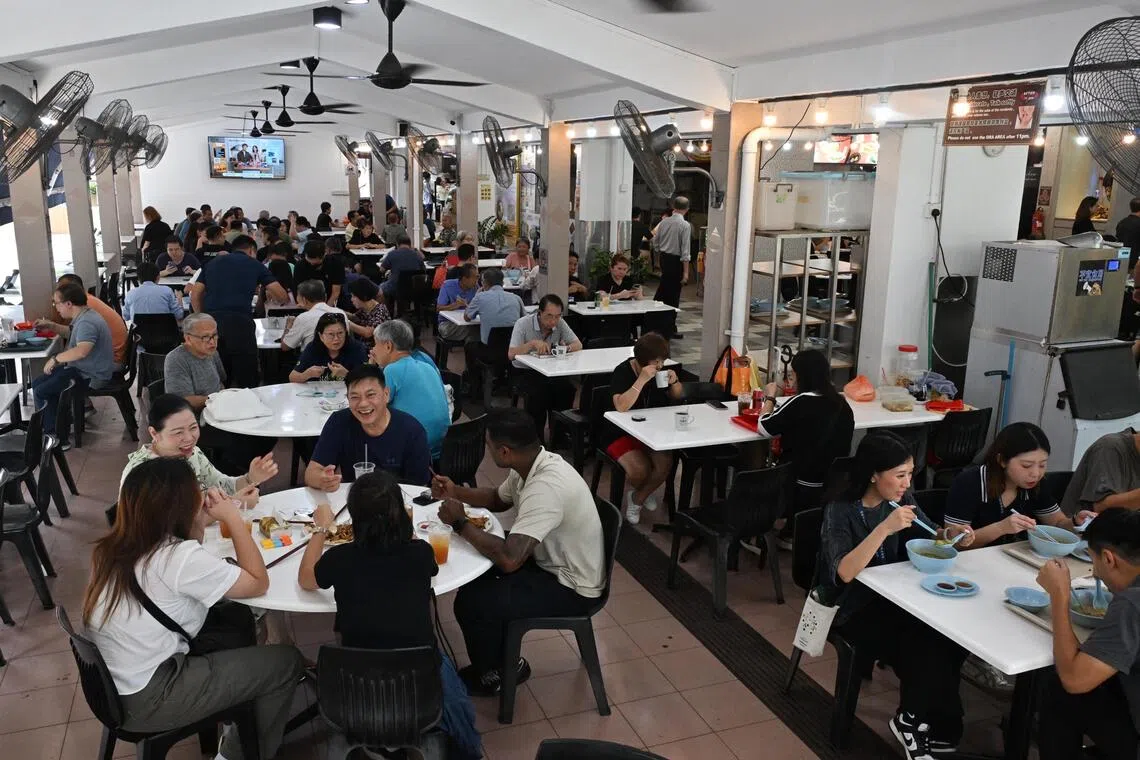
SINGAPORE – Once a sleepy coffee shop with nearly half its stalls vacant, Lau Ka Kopitiam in Bedok North is now buzzing at meal times and crowded on weekends.
The transformation took place within a year of second-generation fish soup stall owner Low Boon Chuan taking over the coffee shop in October 2025 with a $300,000 bank loan.
At the time, three of its eight food stalls had been empty for almost a year. When Low learnt that the previous operator wanted to lease out the premises, he was worried that whoever took over might raise his rent.
Another coffee-shop operator across the road, who had heard the news, offered him a stall. But Low turned him down.
His Boon Keng Road Fish Head Bee Hoon stall, started by his mother in a Boon Keng Road industrial canteen in 1998, has been at the present coffee shop since 2005.
“My weak point is that I wanted to keep my stall here because business is stable,” says Low, 40.
Instead of waiting to see who would become his new landlord, he approached the operator and landlord to take over the coffee shop himself.
Coffee-shop takeover
Of the $300,000 loan, $170,000 went towards the takeover fee. Rent for the entire coffee shop at Block 416 Bedok North Avenue 2 is $34,000 a month.
But instead of passing the cost on to his tenants, Low cut rent by about 30 per cent to fill the three vacant stalls.
It was a practical decision. Many customers who come for his fish soup skip ordering drinks. Now that he is operating the coffee shop and drinks stall, he needed more food choices to draw diners and boost beverage sales.
He brought in tenants including Chong Pang Huat, known for barbecued chicken wings and satay, as well as a zi char stall and economy bee hoon stall.
Low also spent more than $10,000 to spruce up the premises, including installing 17 large wall fans, changing the tables and putting up a new awning.
He renamed the place Lau Ka Kopitiam, a play on his surname and the Hokkien term for “downstairs”. The name reflects his desire for the coffee shop to become a meeting place for residents in the neighbourhood.
He also hired two dishwashers, who help stallholders wash crockery and clear trays, keeping the dining area cleaner than before. Low says the improved hygiene has also reduced the number of birds at the coffee shop.
He plans to renovate the toilet next and make it more senior-friendly. This is partly for the sake of his mother, Tan Chwee Lian, 71, who still works part-time as a cashier at the fish soup stall.
Low no longer allows her to cook, despite requests from some customers. In the last few years, she had fallen several times, including on the slippery kitchen floor. One fall in the toilet left her hospitalised with a broken wrist.
Despite his efforts to support his tenants, the journey to date has not been without casualties.
The economy bee hoon stall threw in the towel after six months and was replaced by a satay bee hoon stall. A Thai stall selling laksa and fried chicken called it quits after seven months.
But Low managed to bring in an established name, Eng Kee Chicken Wings, which opened its Bedok North outlet there on Sept 11.
Today, all eight food stalls are occupied.
[[nid:744346]]
Taking a pay cut
Yet, for all the outward signs of success – full tenancy, packed weekend tables and motorists sometimes struggling to find a parking space in the carpark behind – Low says running the coffee shop is less profitable for him than running only his fish soup stall.
He earns a four-figure salary and has cut his own pay by about 30 per cent, using profits from his stall to help subsidise rents for newer tenants.
Nearly a year after lowering rents, he has kept them at the reduced level. “I want all the stalls in my kopitiam to have proper earnings rather than to close down and I have to bring in new tenants,” he says.
Asked if the gamble has been worth it, he says it is too early to tell. He still has another four years to repay the loan. He reckons it may take another two years to break even.
His reason for taking the risk was simply to survive. He had no intention to be a coffee-shop boss.
Low had helped his parents, who started as fishmongers, at their wet market stall and later started selling fish soup, from the age of seven. But as a teenager, he was more interested in basketball and billiards.
He failed his N levels and O levels, which he took as a private candidate. He then enlisted early for national service and signed on as a regular, but quit in 2008 as he wanted a higher income.
The army, he says, taught him discipline and how to push himself.
“There were times when I felt I couldn’t pull through the hardship. But when I felt physically stretched to my limits, somehow I managed to push through.”
After leaving the army, he started a mobile car-grooming business, buying a second-hand van with a $32,000 bank loan. But business was slow and he supplemented his income by doing deliveries.
His mother asked him around 2010 to join her business, saying she was getting older and that he should learn to cook and run the stall.
He turned her down several times before joining part-time in 2011, working from 7pm to 11pm while continuing his delivery jobs.
“I wasn’t close to my mother at that time. I was usually curt to her and felt irritable whenever she spoke to me,” he says.
He manned the cashier and took orders. “I didn’t enjoy working at the stall. It was hot and exceedingly humid, especially with the boiling vats of stock and soup.”
Turning point
What changed his mind was seeing another cook behave rudely towards his mother.
Low decided to learn to prepare the stocks and cook a la minute for customers so she would not have to depend on the employee. It was physically tiring, but he persisted.
Customers shunned him because he did not give as many fish slices as his mother. Some retracted their orders when they saw him cooking. Others specifically asked his mother not to let him prepare their food.
“I would tell them, ‘Then don’t eat’,” he says. “I chased a lot of customers away.
“I was young and took offence easily. I couldn’t control my emotions.”
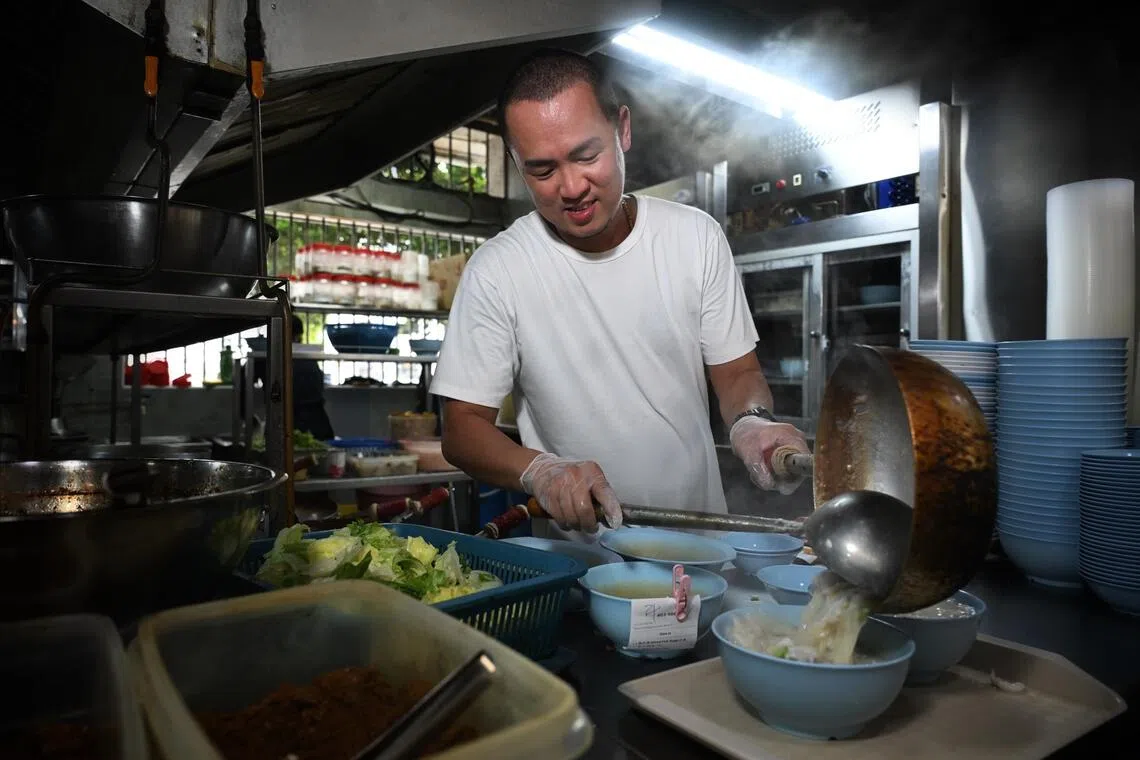
It took him about a year to master cooking the fish soup.
Working alongside his mother also changed their relationship.
“Working at the stall made me realise how much my mother had sacrificed to raise me and keep the business running,” he says.
By 2015, Low had joined the stall full-time on a fixed monthly salary of $2,000.
He began noticing weaknesses in the business.
“Despite the long queues, the business was not profitable because my mother had no idea about costing. She undercharged customers and often gave regulars too much fish or big discounts,” he says.
He also discovered money disappearing from the till.
Low officially took over the business in 2016, introducing upfront payment and a pager system, and tightening portion and cost controls.
He kept his mother’s recipes largely intact, adding housemade minced pork balls flavoured with flatfish to the fish soup.
The stall’s premium signature is Sliced Red Grouper Soup ($9 for small, $13 for medium and $17 for large).
Low prepares the stock himself after closing. Dried flatfish is fried whole and crushed before being added to batang bones and large pork bones.
The stock takes three hours to boil. Fresh fish, including red grouper, arrives daily from a supplier at Jurong Fishery Port.

Another popular item is Pig’s Stomach Soup ($5 for small, $8 for medium and $11 for large). Tender slices of pig’s stomach come in a cloudy white broth with a sharp spicy kick from white peppercorns.

By 2024, Low had overhauled the team of six fish soup stall employees and trained them well enough for the business to operate without him constantly being there.
He finally had more time to go fishing and deliver donated meals to nursing homes and senior centres, something he has done for close to a decade.
But taking over the coffee shop led to a drastic change in his routine and lifestyle.
Low, who describes himself as an introvert, found himself having to change even his personality.
In the early months, he would arrive at 8am, leave at 10am to make charity deliveries, return for the lunch crowd, go home for a break, then come back at 5pm to chat and sometimes drink with customers until close to midnight.
He wanted to build rapport, get feedback and create some buzz.
The frenetic pace took a toll. Low lost 9kg in his first three months, dropping from 80kg to 71kg.
“I drank so much, I lost my appetite,” he says. These days, he starts work at around 10am, but still ends his day close to midnight as many of his regular customers have turned into friends and enjoy his company at the coffee shop.
There was also a win for his own stall in July, when Boon Keng Road Fish Head Bee Hoon was named a new entrant on the Michelin Guide Singapore Bib Gourmand list.
There are now 16 employees across Lau Ka Kopitiam, including the six at his fish soup stall. Low has no fixed day off.
Apart from work, he is in a long-distance relationship with a 39-year-old Taiwanese kindergarten principal whom he met at a temple dinner while holidaying in Taiwan two years ago.
He says marriage will be further down the road, as “it is still early in our relationship”.
Nor does he plan to take over another coffee shop.
“I prefer to have a more relaxed lifestyle. I just want enough money to live the life I like, do my charity work, deliver food and have time to go fishing.”
[[nid:739489]]
This article was first published in The Straits Times. Permission required for reproduction.
Top In Asia


